For orders up to 3k, a 50% advance payment is required for order confirmation.

For orders up to 3k, a 50% advance payment is required for order confirmation.
Within Lahore PKR 250–600 (area-wise) | Out of Lahore PKR 400 (0–3 kg) | Above 3 kg +PKR 130/kg
Disposable Napkins & Table Tissues in Pakistan: Bulk Buying Guide for Restaurants
- Hamza
- No Comments
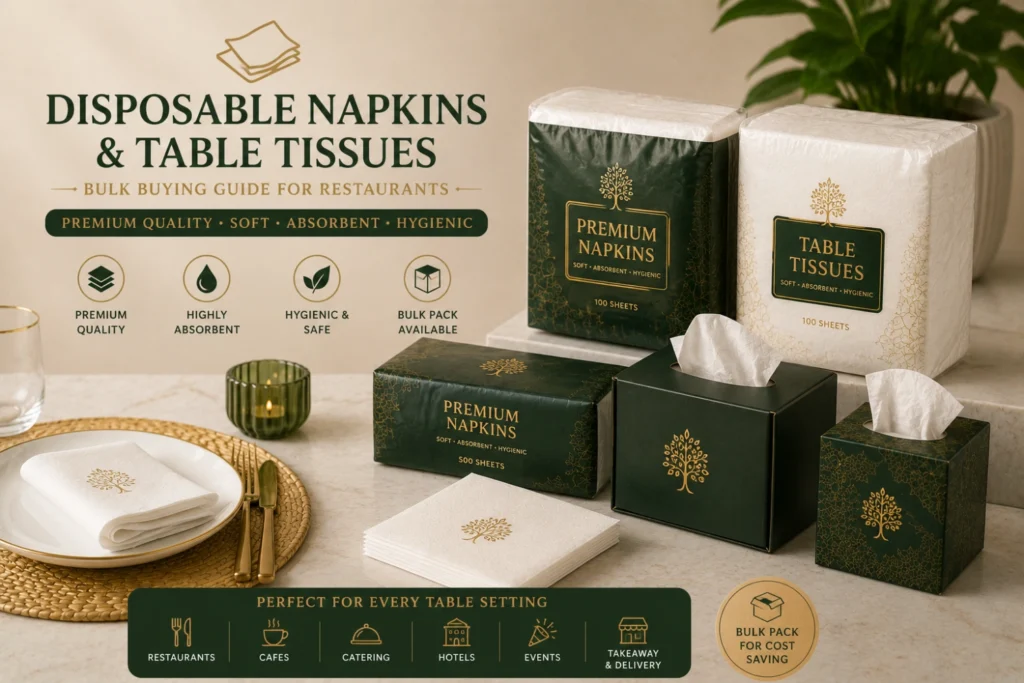
The best disposable napkins for restaurants in Pakistan are 2-ply or 3-ply table napkin tissues, sized and folded to match how they’ll be used — dispenser-style for quick-service counters, and folded dinner napkins for sit-down tables — bought in bulk from a wholesale supplier rather than retail packs, since restaurants go through napkins in high volume and retail pricing adds up fast.
Napkins are one of those packaging items restaurant owners tend to under-plan for. They’re cheap per piece, so it’s easy to treat napkin buying as an afterthought compared to boxes, cups, or cutlery. But because consumption is so high — every table setting, every takeaway order, every spill — getting the ply, GSM, fold, and bulk sourcing wrong quietly costs more over a month than most owners realize, either through overspending on unnecessarily premium napkins or under-buying and running out mid-service. And beyond the cost math, napkin quality is a presentation signal customers register without thinking about it: a thin napkin that falls apart on the first wipe reads as a cheap operation, while one that absorbs a spill and still feels substantial reinforces the same trust a clean table or a sharp menu does.
Ply and GSM: The Two Numbers That Actually Determine Quality
Most buyers stop at ply count, but ply alone doesn’t tell the full story — GSM (grams per square meter, a measure of paper weight per layer) is what actually determines how a napkin performs, and two napkins with the same ply count can feel completely different depending on it.
| Type | Typical GSM per ply | Best for | Feel |
|---|---|---|---|
| 1-ply | ~15–18 GSM | Quick-service counters, fast food, high-volume low-mess settings | Thin, economical, used briefly and discarded |
| 2-ply | ~30–35 GSM per ply | Most restaurants and cafés — the industry-standard balance of cost and absorbency | Comfortably absorbent without feeling premium |
| 3-ply | ~35+ GSM per ply | Premium dine-in, hotels, formal events | Soft, substantial, reinforces a higher price point |
A useful rule of thumb: well-made 2-ply napkins with solid GSM often outperform low-quality 3-ply ones, since basis weight and pulp quality matter more to how a napkin actually feels than layer count alone. If a supplier can’t tell you the GSM, that’s worth treating as a quality flag, not just a ply number.
Virgin vs. recycled pulp is the other variable worth asking about. Virgin pulp is softer and more premium-feeling; quality recycled paper typically delivers 80–90% of that quality at a meaningfully lower cost, which makes it the more efficient choice for high-volume settings where customers aren’t scrutinizing napkin texture closely.
Fold Types and Where Each One Fits
- Quarter-fold – The most common fold for general table service and takeaway orders; compact and easy to stack.
- Interfold/dispenser-style – Designed for pull-style napkin dispensers, common at quick-service counters and buffet stations where customers self-serve.
- Tall-fold – A narrow, upright fold used in dispensers at drink stations and self-service areas.
- Custom/printed folds – Used by restaurants and hotels wanting a branded look, often paired with logo printing for a more premium table setting.
Choosing fold type based on how napkins are actually accessed (self-serve dispenser vs. table-set placement) affects both customer experience and how quickly staff need to restock during service. It’s also worth ordering the dispenser and the napkins from the same supplier where possible — mismatched fold sizing between a generic dispenser and a differently-cut napkin is a common, avoidable source of jams and waste.
Sizing: Table Napkins vs. Everyday Tissue
Napkin size should track service style rather than being a fixed default across every table type:
- ~30–33 cm – Standard for casual dining and quick-service — enough coverage without overbuying paper for light use.
- ~40–45 cm – Better suited to formal dine-in, banquets, and messier foods, where a larger napkin does more work per spill and reads as more generous to the guest.
It’s also worth distinguishing between two commonly confused categories:
- Table napkin tissue – Larger, designed specifically for dining tables, formal place settings, and events where presentation matters.
- General napkin tissue – Smaller, more economical tissue meant for quick wipe-downs, counters, and lower-presentation use cases like fast food or takeaway packing.
Restaurants often need both: table napkin tissue for dine-in service, and a smaller, cheaper napkin tissue for packing takeaway orders or wiping down counters between customers.
How to Estimate Bulk Napkin Needs
A simple way to avoid over- or under-ordering is to estimate based on covers (customers served) rather than guessing:
- Quick-service/takeaway – Roughly 1–2 napkins per order on average
- Casual dine-in – Roughly 2–4 napkins per customer per meal
- Formal dine-in/events – Often 1 folded napkin per place setting, plus extras for spills and replacements
Multiplying average daily covers by these rough ranges gives a monthly bulk order estimate that’s far more reliable than ordering “a box or two” and reordering reactively.
A quick way to turn this into an annual budget:
Daily covers × napkins per cover × 365 days × cost per napkin = annual napkin spend
For example, a casual dine-in restaurant serving 150 covers a day, averaging 3 napkins per cover, is going through roughly 164,000 napkins a year — at that volume, even a small per-napkin price difference between suppliers compounds into a meaningful annual cost, which is exactly why comparing cost-per-napkin (not cost-per-pack) at the sourcing stage matters more than it seems at first glance.
What to Check When Sourcing in Bulk in Pakistan
- Food-grade and hygiene certification – Confirm the tissue is manufactured to food-service hygiene standards, not just general-purpose paper.
- GSM and ply consistency across a batch – Ask for a sample before a large order and check the weight feels consistent; inconsistent quality between batches is a common complaint with lower-cost suppliers.
- Custom branding options – Many suppliers offer printed table napkin tissue with logos, useful once a restaurant has consistent volume to justify the added cost.
- MOQ and storage space – Bulk napkin cartons take up real storage room; confirm minimum order quantities fit your back-of-house space before committing to a large order.
- Cost per napkin, not per pack – Compare suppliers on a per-sheet or per-100-count basis rather than sticker price per pack, since pack sizes vary widely between suppliers.
- Consistency across service points – Avoid mixing napkin quality across the same restaurant (premium at some tables, budget at others); customers notice the inconsistency more than they’d notice a uniformly mid-tier choice.
FAQs
What ply napkin is best for restaurants?
2-ply table napkin tissue is the standard choice for most restaurants and cafés, balancing absorbency and cost for everyday dine-in service. 3-ply is better suited to premium or formal dining, while 1-ply is more appropriate for high-volume, low-mess settings like quick-service counters.
Does GSM matter more than ply count?
Both matter, but GSM (paper weight per layer) is often the better indicator of actual quality — a well-made 2-ply napkin with solid GSM can outperform a thin, low-GSM 3-ply one. When comparing suppliers, it’s worth asking for GSM specifically rather than relying on ply count alone.
How many napkins should a restaurant order per month?
This depends on daily covers and service style, but a rough starting point is 1–2 napkins per takeaway order and 2–4 napkins per dine-in customer per meal. Multiplying this by average daily customer volume — and by 365 for an annual figure — gives a far more reliable bulk estimate than ordering reactively.
What’s the difference between table napkin tissue and regular napkin tissue?
Table napkin tissue is generally larger (around 40–45 cm for formal settings) and designed for dining table place settings and formal presentation, while regular napkin tissue is smaller and more economical, better suited to counters, takeaway packing, and quick wipe-downs.
Can restaurants get custom-printed napkins in Pakistan?
Yes, many wholesale suppliers offer custom-printed napkin tissue with restaurant logos or branding, typically available once order volume justifies the added printing cost. This is a common way for dine-in restaurants and hotels to reinforce brand identity on the table.
Is it cheaper to buy napkins in bulk from a wholesale supplier?
Yes, buying napkins in bulk from a wholesale packaging supplier is almost always cheaper per unit than buying retail packs, especially for restaurants with steady daily consumption. The main trade-off is upfront storage space, which is worth planning for before placing a large order.
Related Posts:
Custom Ramadan Gift Boxes in Pakistan: A Buying Guide
October 5, 2026
No Comments
A Ramadan gift box is only as good as the box itself. The contents matter,
Coffee Shop Packaging in Pakistan: Cups, Lids, Holders & Coffee Pouches
October 4, 2026
No Comments
A coffee shop needs two very different kinds of packaging. One for drinks served to
Kraft & Paper Packaging in Pakistan: Complete Guide for Businesses
October 3, 2026
No Comments
Kraft and paper packaging covers more ground than most businesses realize. Boxes. Bags. Trays. Wraps.
FEEL FREE CONTACT US
info@packaigngmaster.pk
923153127889
Packaging Master, serving Pakistan since 2020, specializes in premium disposable packaging boxes, food packaging, e-commerce cartons, kraft items, and fully customized solutions. Trusted by restaurants, SMEs, retail stores, and online sellers, we deliver durable, eco-friendly packaging with fast nationwide delivery and competitive pricing—making us a leading choice for reliable, high-quality packaging in Pakistan.
Company
Products
Contact Detail
- Rafi Group Landmark Plaza LG 60,61 Jail Road, Lahore
- Phone: +923153127889
- Email: info@packagingmaster.pk
© 2026 Packaging Master. All Rights Reserved.