For orders up to 3k, a 50% advance payment is required for order confirmation.

For orders up to 3k, a 50% advance payment is required for order confirmation.
Within Lahore PKR 250–600 (area-wise) | Out of Lahore PKR 400 (0–3 kg) | Above 3 kg +PKR 130/kg
Fast Food Packaging Ideas for Restaurants in Pakistan
- Hamza
- No Comments
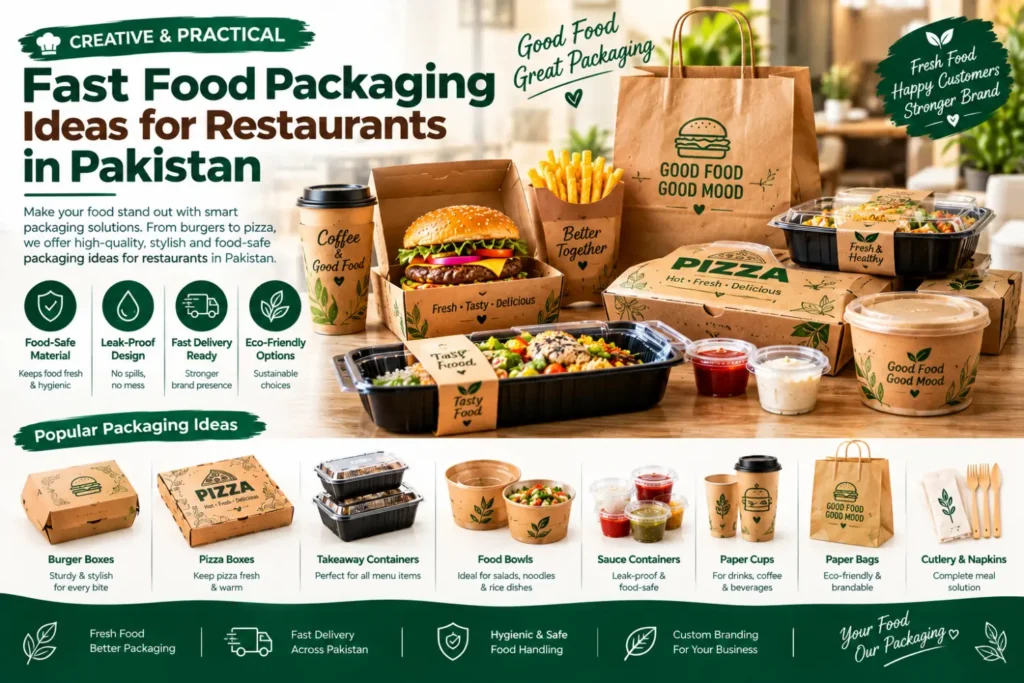
The best fast food packaging ideas treat every box, wrapper, and bag a customer receives as a small piece of marketing, not just a container — branding on the outside, a thoughtful unboxing moment on the inside, and material choices that say something about the restaurant’s standards before the food is even tasted. For Pakistani restaurants competing on crowded delivery apps where a customer never sets foot in the actual location, packaging is often the only physical brand touchpoint that exists, which makes it worth more creative attention than most restaurants give it.
This is a companion piece to our practical guides on specific fast food packaging — including our French fries box guide, which covers grease resistance and custom options for that category specifically. This post is about the ideas layer on top of that groundwork — what actually makes packaging memorable, shareable, and recognizably yours, once the functional basics (like burger boxes, shawarma boxes, and pizza boxes) are already sorted.
1. Let Color Do Some of the Talking
Color is one of the fastest, cheapest ways to make packaging distinctive without a full redesign. Warm tones (red, orange, yellow) are widely associated with appetite and energy, which is part of why they dominate fast food branding globally, while green and earthy kraft tones signal freshness or a natural, health-conscious positioning. Choosing a consistent color story across boxes, bags, and cups — rather than whatever a supplier has in stock that week — is a simple way to make an order instantly recognizable, even before a logo is visible.
2. Use the Inside of the Box, Not Just the Outside
Most restaurants only think about printing a logo on the outer surface, but the inside lid of a burger or pizza box is prime, often-overlooked space. A short thank-you message, a small illustration, or a QR code linking to a review page or loyalty program turns a moment the customer would otherwise ignore into a small extra touchpoint — and costs very little extra once a print run is already set up.
3. Build in a Reason to Photograph It
Delivery orders get photographed and shared constantly, and packaging that’s even slightly more considered than a plain box tends to get more of that attention. A visible window on a bakery or brownie box, a distinctive color combination, or a simple branded pattern gives customers something worth pointing a camera at — which functions as free, organic marketing every time it happens.
4. Make Sustainability Visible, Not Just Real
Many Pakistani restaurants have already switched to kraft, bagasse, or other eco-friendlier materials, but the sustainability choice often isn’t communicated anywhere on the packaging itself. A small printed line — “recyclable packaging” or “made from sugarcane fiber” — turns a cost or compliance decision into a visible brand value, which matters increasingly to customers who actively choose based on it.
5. Match Packaging Personality to Menu Personality
A casual burger joint, a premium steakhouse doing takeout, and a health-focused salad brand shouldn’t necessarily use the same packaging style even if they’re ordering from the same supplier. Kraft and simple typography suit a casual or health-forward brand; bolder colors and glossy finishes suit a brand leaning into indulgence; minimal, white-based packaging suits a premium or upscale positioning. The packaging should read as consistent with what’s actually on the menu.
6. Use Personalization for High-Value Orders
Printing a customer’s name, a short occasion-specific message, or a special note on packaging for larger catering orders, birthday orders, or repeat customers is a small gesture that’s disproportionately memorable. It’s not practical for every single order, but for higher-value or occasion-based orders, it’s a low-cost way to stand out.
7. Don’t Let Supporting Packaging Undercut the Main Box
A beautifully branded burger box loses some of its impact if it arrives inside a completely generic, unbranded plastic bag, or alongside a mismatched sauce cup and plain napkin. Extending even simple branding — a repeated color, a small printed logo — across the full delivery package, not just the primary box, keeps the presentation consistent from the moment the bag is opened.
8. Consider Seasonal or Limited-Run Designs
Packaging tied to Ramzan, Eid, or a specific seasonal menu can create a sense of limited-time specialness that plain, year-round packaging can’t. This doesn’t need to mean a full redesign — even a seasonal sticker, a different accent color, or a small printed graphic on standard packaging can signal “something different is happening right now” to a repeat customer.
Where to Start
Not every idea here needs to happen at once, and a small or newer restaurant shouldn’t feel pressure to implement all eight before its next packaging order. A practical starting point:
- Get the functional basics right first — see our French fries box guide and paper bags guide for material and sizing choices by item type, or browse burger, shawarma, and pizza boxes directly.
- Pick one consistent color story and apply it across the main box and supporting items.
- Add one small branded touch inside the packaging (a message, a QR code) as a low-cost first step.
- Layer in bigger ideas — personalization, seasonal designs — as order volume and budget allow.
FAQs
Do small or new restaurants need custom packaging ideas, or is this just for big brands?
Even small, simple upgrades — a consistent color choice, a small printed message, matching the packaging style to the menu’s personality — are accessible to a small or newly launched restaurant and don’t require the packaging budget of a large chain. Custom printing at scale becomes more relevant as order volume grows.
What’s the easiest, lowest-cost packaging idea to start with?
Choosing one consistent color story across all packaging items (boxes, bags, sauce cups) is generally the lowest-cost, highest-impact starting point, since it doesn’t necessarily require custom printing — just consistent supplier ordering.
Does eco-friendly packaging actually influence customer perception?
Yes, but only when it’s communicated — many restaurants have already switched to more eco-friendly materials without mentioning it anywhere on the packaging, which means the brand value of that decision often goes unnoticed by customers.
Should every order get personalized packaging?
No, personalization is generally more practical and impactful for higher-value, occasion-based, or catering orders rather than every standard order, where the cost and effort wouldn’t match the return.
How does this differ from a packaging buying guide?
This post focuses on branding, presentation, and creative ideas layered on top of packaging choices, while a buying guide focuses on the functional side — sizing, material, and sourcing for each food type. Most restaurants need both: the functional guide to choose the right packaging, and these ideas to make it memorable once chosen.
Related Posts:
Custom Ramadan Gift Boxes in Pakistan: A Buying Guide
October 5, 2026
No Comments
A Ramadan gift box is only as good as the box itself. The contents matter,
Coffee Shop Packaging in Pakistan: Cups, Lids, Holders & Coffee Pouches
October 4, 2026
No Comments
A coffee shop needs two very different kinds of packaging. One for drinks served to
Kraft & Paper Packaging in Pakistan: Complete Guide for Businesses
October 3, 2026
No Comments
Kraft and paper packaging covers more ground than most businesses realize. Boxes. Bags. Trays. Wraps.
FEEL FREE CONTACT US
info@packaigngmaster.pk
923153127889
Packaging Master, serving Pakistan since 2020, specializes in premium disposable packaging boxes, food packaging, e-commerce cartons, kraft items, and fully customized solutions. Trusted by restaurants, SMEs, retail stores, and online sellers, we deliver durable, eco-friendly packaging with fast nationwide delivery and competitive pricing—making us a leading choice for reliable, high-quality packaging in Pakistan.
Company
Products
Contact Detail
- Rafi Group Landmark Plaza LG 60,61 Jail Road, Lahore
- Phone: +923153127889
- Email: info@packagingmaster.pk
© 2026 Packaging Master. All Rights Reserved.