For orders up to 3k, a 50% advance payment is required for order confirmation.

For orders up to 3k, a 50% advance payment is required for order confirmation.
Within Lahore PKR 250–600 (area-wise) | Out of Lahore PKR 400 (0–3 kg) | Above 3 kg +PKR 130/kg
Where to Buy Wholesale Packaging in Pakistan: A Buyer’s Guide
- Hamza
- No Comments
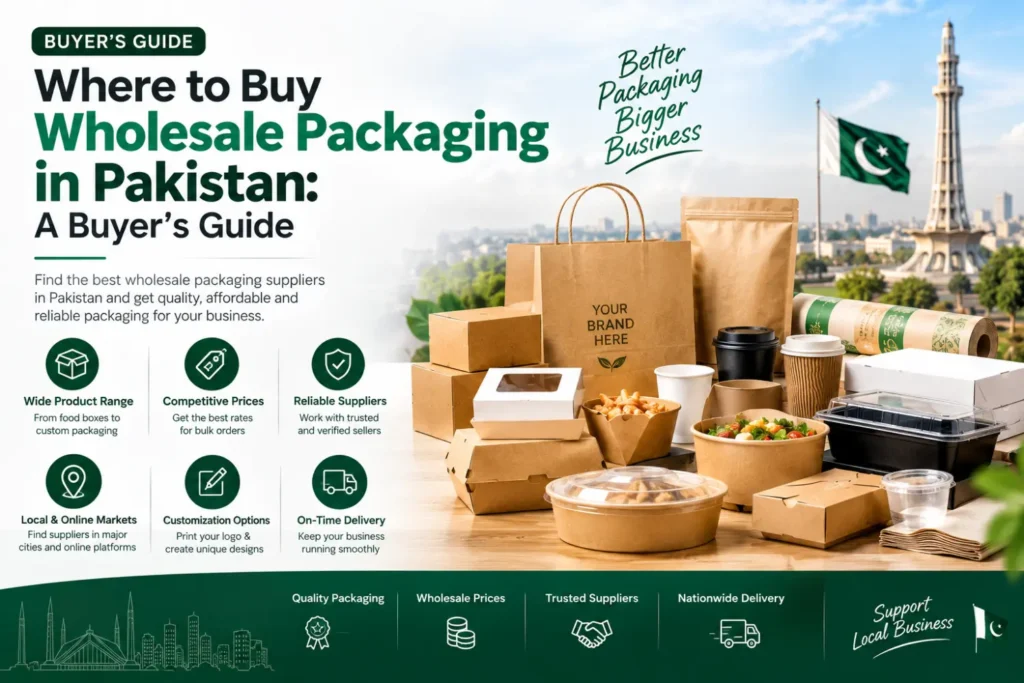
The best place to buy wholesale packaging in Pakistan depends on order size and urgency: traditional wholesale bazaars (Jodia Bazar in Karachi, Brandreth Road in Lahore) work for small, immediate, cash-based purchases where physically inspecting stock matters, while online wholesale suppliers work better for planned bulk orders, custom printing, consistent quality across repeat orders, and nationwide delivery without a market visit. Most growing businesses end up using bazaars for emergency top-ups and online suppliers for their real, recurring packaging supply — understanding why each exists helps avoid overpaying at one or getting stuck waiting on the other.
Packaging is one of those costs that quietly compounds — a business buying retail-priced packaging in small batches is paying significantly more per unit than one buying wholesale, and that gap only grows as order volume increases. This guide covers where wholesale packaging actually comes from in Pakistan, how to tell a reliable supplier from a risky one, and what to actually look for by product category — without the generic “buy in bulk, save money” advice that doesn’t help anyone make an actual decision.
Bazaar Sourcing vs. Online Wholesale: The Honest Comparison
Both channels are legitimate, but they solve different problems — the mistake is assuming one is universally better.
| Traditional Wholesale Bazaars | Online Wholesale Suppliers | |
|---|---|---|
| Best for | Urgent, same-day needs; physically inspecting stock; very small one-off buys | Planned bulk orders; custom printing; repeat/recurring supply |
| Price transparency | Often requires negotiation; prices vary by buyer and relationship | Generally listed upfront, easier to compare |
| Consistency across orders | Variable — depends on which stall, which day, which stock batch | More consistent when sourced from one supplier repeatedly |
| Custom branding/printing | Limited, usually requires a separate printer | Frequently offered as part of the order process |
| Delivery | Usually self-pickup or local-only | Nationwide delivery standard |
| Paper trail/accountability | Often cash-only, verbal agreements | Typically invoiced, easier to dispute or return |
Karachi’s Jodia Bazar and Bolton Market, and Lahore’s Brandreth Road, remain genuinely useful for businesses that want to see and touch stock before buying, or need something the same day. But for a business trying to build a consistent, repeatable packaging supply — matching quality, matching branding, predictable lead times — an established online wholesale supplier solves problems the bazaar model structurally can’t.
Red Flags to Watch for When Buying Wholesale
This is the part most guides skip, and it’s the part that actually protects a buyer’s money:
- No samples offered before a bulk commitment – Any supplier unwilling to provide a sample, even a small paid one, is asking for trust it hasn’t earned yet.
- Cash-only with no invoice or order confirmation – Makes it very difficult to dispute a wrong or damaged bulk order after the fact.
- Vague or unverifiable food-grade claims – “Food safe” said verbally isn’t the same as a supplier who can point to actual certification or consistent sourcing practices.
- No clear MOQ or lead time upfront – A supplier who can’t tell you minimum order quantity or turnaround time in the first conversation is a sign of disorganized fulfillment, which tends to show up later as missed deadlines.
- Pressure to commit to a large order before a sample or small trial run – Reasonable suppliers expect new buyers to test quality first; pressure to skip that step is a warning sign, not a discount.
None of these automatically mean a supplier is dishonest, but each one increases the real risk of a bulk order going wrong with no easy way to fix it.
What to Actually Check Before Committing to a Supplier
- Sample-test with your real product – Generic samples don’t tell you how packaging performs with your actual food, weight, or use case; always test with what you’ll really be packing.
- Confirm GSM and material specs directly – GSM (grams per square meter) is the actual indicator of paper/board strength, more reliable than a supplier’s general “sturdy” or “premium” description.
- Ask about printing method for custom orders – Digital printing suits smaller, faster runs; offset printing is more cost-effective at higher volumes but takes longer to set up. Knowing which one a supplier uses (and offers) affects both your cost and your timeline.
- Clarify MOQ per product category, not just overall – A supplier’s minimum for plain stock boxes can be very different from their minimum for custom-printed pouches; don’t assume one MOQ applies across everything.
- Get pricing at more than one quantity tier – A supplier who can clearly break down cost at, say, 500 / 2,000 / 5,000 units is easier to plan a growing business around than one who only quotes a single volume.
Packaging by Category: What’s Actually Available
Rather than a generic list, here’s what to look for by category, matched to real product types:
Food & Fast Food Packaging
Burger boxes, shawarma boxes, pizza boxes, and kraft sandwich boxes cover most fast food and café needs, generally available in kraft, cardboard, and bagasse material options depending on grease resistance and eco-positioning needed.
Bakery & Gifting
Cake boxes, gable boxes, chocolate boxes, chocolate cavity boxes, and chocolate wrappers cover bakeries and chocolatiers, from the outer presentation box down to individually wrapped pieces.
Bags & Pouches
SOS paper bags, kraft paper bags with rope handles, and gift bags serve retail and gifting, while kraft stand-up pouches, seal retort pouches, and clear zipper pouches serve food brands needing barrier protection or shelf-stable packaging.
Disposables & Beverage Packaging
Single wall, double wall, and ripple wall coffee cups, along with paper straws, cover cafés and beverage-focused businesses.
Everyday Restaurant Supplies
Table napkin tissue, butter paper and parchment paper, and wooden cutlery and chopsticks round out day-to-day restaurant and catering supply needs.
Understanding What Actually Drives Wholesale Cost
Regardless of which supplier or channel a business uses, the same three factors determine pricing:
- Material – Plain kraft and standard cardboard are the most economical baseline; rigid board, bagasse, and specialty coatings cost more.
- Print method and complexity – Simple logo printing costs less than full-color, multi-side custom designs; digital suits small runs, offset suits large ones.
- Order quantity – Per-unit cost drops meaningfully as volume increases, which is the entire mechanical reason wholesale buying saves money over retail in the first place.
Understanding these three levers lets a buyer negotiate and compare intelligently, rather than just asking “what’s your best price” and hoping for a fair answer.
FAQs
Is it better to buy packaging from a bazaar or online in Pakistan?
It depends on the order. Bazaars work well for urgent, small, one-off purchases where inspecting stock in person matters. Online wholesale suppliers work better for planned bulk orders, custom printing, and businesses that need consistent quality and nationwide delivery across repeat orders.
What is a typical minimum order quantity (MOQ) for wholesale packaging?
MOQ varies significantly by product and by whether the order includes custom printing. Plain stock items often have lower minimums than custom-printed runs, since custom printing requires setup specific to that order. It’s best to confirm MOQ per product category rather than assuming one number applies across a supplier’s full catalog.
How can I tell if a wholesale packaging supplier is trustworthy?
Look for a supplier willing to provide samples before a bulk commitment, clear upfront MOQ and lead time information, verifiable food-grade claims for food packaging, and a proper invoice or order confirmation rather than a cash-only, verbal-only transaction.
Does custom printed packaging cost significantly more than plain packaging?
Custom printing adds cost, but the increase is driven more by print method and order volume than a fixed markup — digital printing is cost-effective for smaller runs, while offset printing becomes more efficient at higher volumes. Plain stock packaging with simple logo printing is usually a moderate step up from unprinted packaging, not a dramatic one.
Can I get wholesale packaging delivered nationwide in Pakistan?
Yes, most established online wholesale suppliers deliver nationwide, covering major cities including Lahore, Karachi, and Islamabad. This is one of the clearest advantages online sourcing has over bazaar-based buying, which is typically limited to local pickup.
Related Posts:
Custom Ramadan Gift Boxes in Pakistan: A Buying Guide
October 5, 2026
No Comments
A Ramadan gift box is only as good as the box itself. The contents matter,
Coffee Shop Packaging in Pakistan: Cups, Lids, Holders & Coffee Pouches
October 4, 2026
No Comments
A coffee shop needs two very different kinds of packaging. One for drinks served to
Kraft & Paper Packaging in Pakistan: Complete Guide for Businesses
October 3, 2026
No Comments
Kraft and paper packaging covers more ground than most businesses realize. Boxes. Bags. Trays. Wraps.
FEEL FREE CONTACT US
info@packaigngmaster.pk
923153127889
Packaging Master, serving Pakistan since 2020, specializes in premium disposable packaging boxes, food packaging, e-commerce cartons, kraft items, and fully customized solutions. Trusted by restaurants, SMEs, retail stores, and online sellers, we deliver durable, eco-friendly packaging with fast nationwide delivery and competitive pricing—making us a leading choice for reliable, high-quality packaging in Pakistan.
Company
Products
Contact Detail
- Rafi Group Landmark Plaza LG 60,61 Jail Road, Lahore
- Phone: +923153127889
- Email: info@packagingmaster.pk
© 2026 Packaging Master. All Rights Reserved.