For orders up to 3k, a 50% advance payment is required for order confirmation.

For orders up to 3k, a 50% advance payment is required for order confirmation.
Within Lahore PKR 250–600 (area-wise) | Out of Lahore PKR 400 (0–3 kg) | Above 3 kg +PKR 130/kg
Custom Packaging Boxes in Pakistan: Types, Sizes & Pricing Guide for Businesses
- Hamza
- No Comments
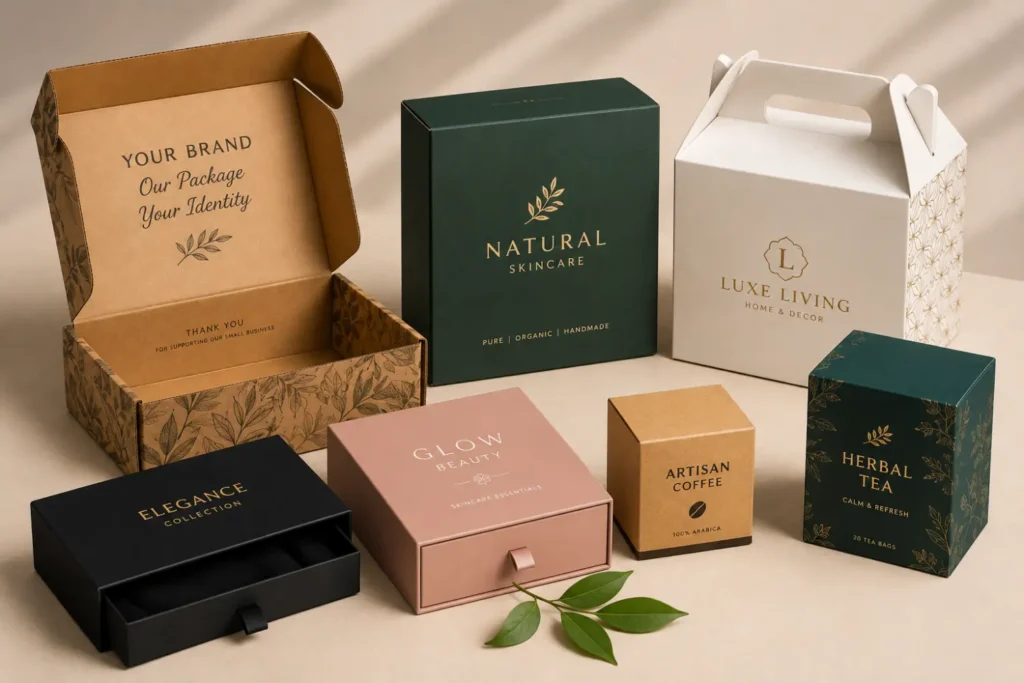
The right custom packaging box for a Pakistani business depends on what’s inside it and how it travels: kraft or corrugated boxes for e-commerce shipping, food-grade kraft or cardboard for bakeries and restaurants, and rigid or gable-style boxes for gifting and premium retail — and the actual cost comes down to three levers (material, print method, and order quantity), not a vague “affordable vs. expensive” split. Understanding those levers before you request a quote is what lets a small business negotiate confidently instead of just accepting the first number a supplier gives.
Custom packaging has genuinely become a branding necessity in Pakistan’s e-commerce and retail boom — a plain box protects a product, but a branded one is doing marketing work every time a customer unboxes it. What most guides on this topic skip is the practical part: which box type actually fits which product, what sizes are realistically available, what a minimum order quantity looks like, and what’s actually driving the price up or down. This guide covers that ground.
Match the Box Type to What You’re Actually Shipping
| Box Type | Construction | Best For | Notes |
|---|---|---|---|
| Kraft boxes | Natural brown kraft board, food-grade | Bakery items, food takeaway, eco-forward retail brands | Widely stocked in standard sizes; strong and grease-resistant |
| Corrugated/e-commerce boxes | Fluted cardboard layers for shock absorption | Shipping, electronics, fragile items | Chosen for transit durability over branding presentation |
| Gable boxes | Kraft, cardboard, or custom-printed with a fold-top carry handle | Gifting, bakery treats, retail takeaway with a premium feel | Combines function (built-in handle) with strong shelf/unboxing appeal |
| Rigid boxes (perfume boxes as an example) | Thick, non-folding board, often with foil or embossed finishing | Perfume, jewelry, cosmetics, luxury gifting | Highest perceived value; higher cost per unit than folding cartons |
| Food-specific boxes (pizza, burger, cake, chocolate) | Purpose-built shapes and materials per food type | Restaurants, bakeries, food delivery brands | Designed around function first (grease resistance, ventilation, window options) with branding built in |
If you sell physical products online with no food or fragility concerns, kraft or corrugated e-commerce boxes cover most needs. If you’re gifting or selling a premium product, rigid or gable-style boxes do more for perceived value. Food businesses need purpose-built boxes — a generic shipping box doesn’t solve grease, heat, or presentation the way a proper burger or pizza box does.
Real Sizes You Can Actually Order
Generic “custom sizing available” claims aren’t useful without a starting reference. As an example, standard stocked kraft box sizes commonly available in Pakistan include:
- 8×8×4 inches
- 8×8×3 inches
- 7.5×5.5×3 inches
- 7.5×4.5×2.5 inches
- 6.5×5×2.5 inches
- 5.5×4×3 inches
These cover most bakery, small retail, and gift-item use cases without needing a custom die-cut, which keeps cost down. Custom sizing beyond these standard options is usually available too, but it typically comes with a higher MOQ and longer lead time, since it requires a new die-cut mold rather than using existing tooling.
What Actually Drives Custom Packaging Pricing
This is the part most guides skip entirely. Three factors determine what you’ll actually pay:
- Material – Kraft and standard cardboard are the most economical; rigid board and specialty finishes (foil stamping, embossing, spot UV) cost meaningfully more per unit.
- Print method and complexity – Single-color or logo-only printing is cheaper than full-color, multi-side branded designs. Digital printing suits smaller runs; offset printing becomes more cost-effective at higher volumes.
- Order quantity (MOQ) – Custom printed packaging almost always has a minimum order quantity, and per-unit cost drops significantly as volume increases. A small business ordering 500 units will pay a noticeably higher per-box price than one ordering 5,000 — this is standard across the industry, not supplier-specific markup.
A practical way to think about it: standard-size, plain kraft packaging is the cheapest entry point; adding custom printing raises cost moderately; adding custom sizing, rigid material, or premium finishing raises it further. Deciding which of these actually matters for your brand — versus which is a nice-to-have — is the real cost-control lever, more than hunting for a universally “cheap” supplier.
Custom Packaging by Business Type
- E-commerce/online retail – Prioritize shipping durability first (corrugated or sturdy kraft), then branding — a beautiful box that arrives crushed does more damage than a plain one that arrives intact.
- Bakeries and food businesses – Purpose-built cake boxes (window options for display), burger boxes, and pizza boxes matter more than generic branding, since function (grease resistance, heat retention, ventilation) directly affects the product itself.
- Cosmetics, perfume, and gifting brands – Rigid or gable-style boxes with premium finishing justify their higher per-unit cost through perceived value, which matters more for these categories than for everyday consumables.
- Small and home-based businesses – Standard stocked sizes with simple logo printing keep MOQ and cost manageable, without needing to commit to custom die-cuts before order volume justifies it.
What to Check Before Choosing a Supplier
- MOQ that matches your actual order volume – Confirm minimums upfront; a supplier’s MOQ for custom printing can be very different from their MOQ for stocked plain boxes.
- Sample before bulk commitment – A physical sample (material feel, print clarity, box strength) tells you more than any spec sheet.
- Lead time for custom vs. stocked sizes – Custom die-cut sizing takes meaningfully longer than ordering from standard stocked dimensions; plan launch timelines accordingly.
- Food-grade certification – Non-negotiable for any box touching food directly, not just wrapped/boxed products.
- Transparent per-unit pricing at different quantity tiers – A supplier who can clearly break down cost at 500 / 1,000 / 5,000 units is easier to plan around than one who only quotes a single volume.
FAQs
What’s the cheapest type of custom packaging box in Pakistan?
Standard-size plain kraft or cardboard boxes with simple logo printing are typically the most affordable custom packaging option, since they avoid the added cost of custom die-cutting, rigid material, or premium finishing.
What is a typical MOQ for custom printed boxes?
MOQ varies by supplier and box type, but custom printed packaging generally requires a higher minimum than plain stocked boxes. It’s best to confirm MOQ directly for your specific box type and size, since custom-sized dies typically carry a higher minimum than standard stocked dimensions.
Are kraft boxes suitable for food packaging?
Yes, food-grade kraft boxes are widely used for bakery items, takeaway food, and other food packaging in Pakistan, valued for being grease-resistant, recyclable, and giving a natural, eco-forward presentation.
How long does custom packaging take to produce in Pakistan?
Standard stocked sizes with simple printing typically have shorter turnaround than fully custom die-cut boxes, since custom sizing requires new tooling. It’s worth confirming lead time directly with a supplier before setting a product launch date around it.
Is rigid packaging worth the extra cost for a small business?
Rigid packaging makes the most sense for premium or gift-positioned products — cosmetics, perfume, jewelry — where perceived value directly supports the price point. For everyday retail or e-commerce items, standard kraft or corrugated boxes with good branding usually deliver better value.
Related Posts:
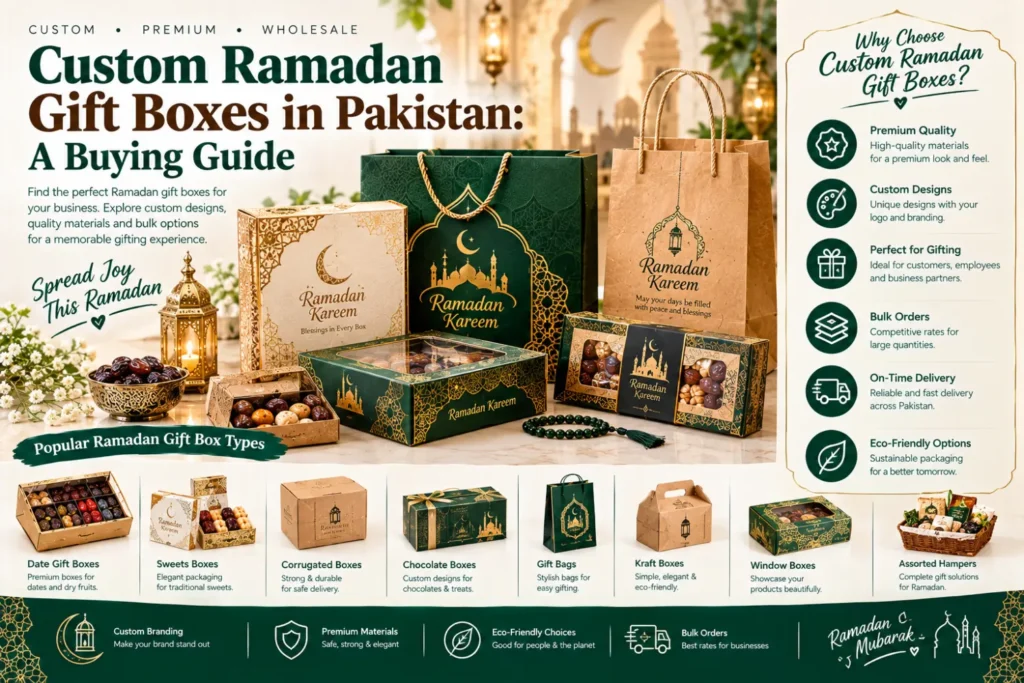
Custom Ramadan Gift Boxes in Pakistan: A Buying Guide
October 5, 2026
No Comments
A Ramadan gift box is only as good as the box itself. The contents matter,
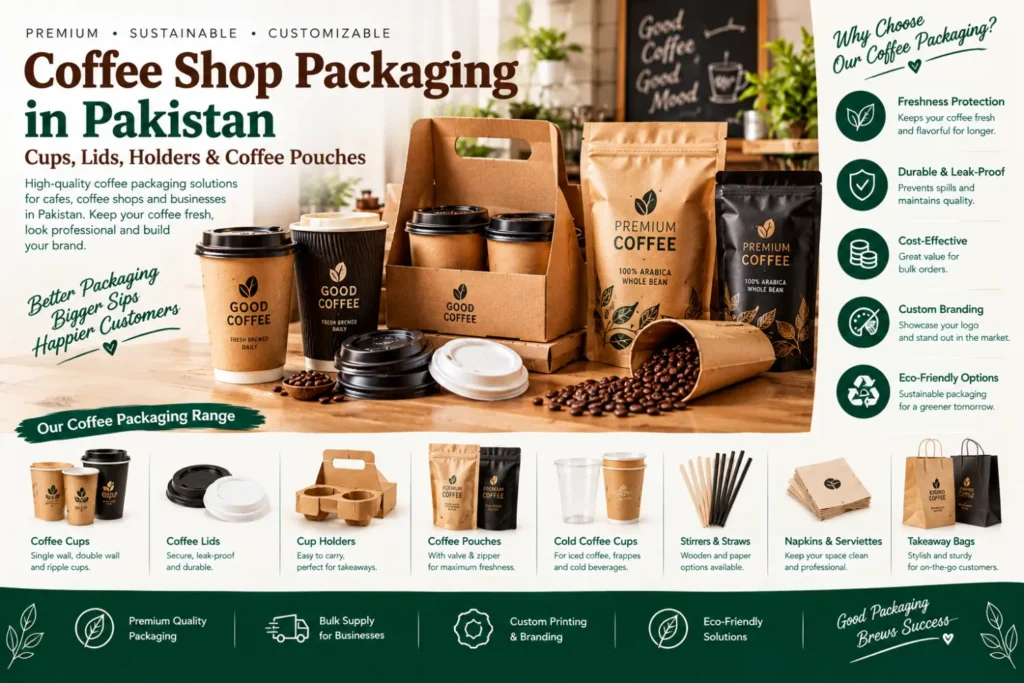
Coffee Shop Packaging in Pakistan: Cups, Lids, Holders & Coffee Pouches
October 4, 2026
No Comments
A coffee shop needs two very different kinds of packaging. One for drinks served to
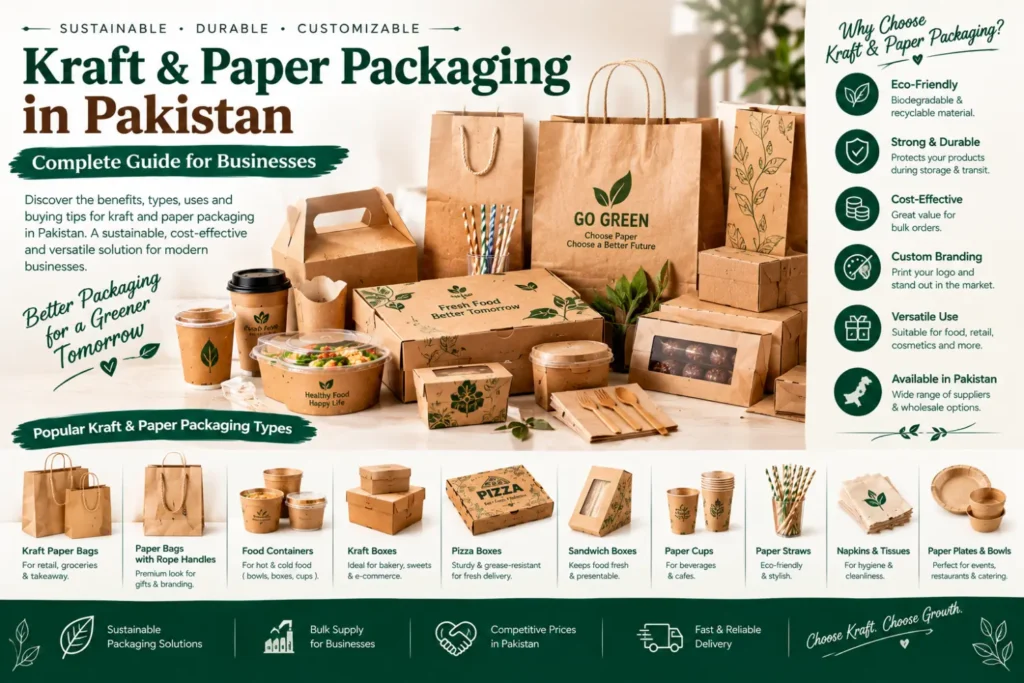
Kraft & Paper Packaging in Pakistan: Complete Guide for Businesses
October 3, 2026
No Comments
Kraft and paper packaging covers more ground than most businesses realize. Boxes. Bags. Trays. Wraps.
FEEL FREE CONTACT US
info@packaigngmaster.pk
923153127889
Packaging Master, serving Pakistan since 2020, specializes in premium disposable packaging boxes, food packaging, e-commerce cartons, kraft items, and fully customized solutions. Trusted by restaurants, SMEs, retail stores, and online sellers, we deliver durable, eco-friendly packaging with fast nationwide delivery and competitive pricing—making us a leading choice for reliable, high-quality packaging in Pakistan.
Company
Products
Contact Detail
- Rafi Group Landmark Plaza LG 60,61 Jail Road, Lahore
- Phone: +923153127889
- Email: info@packagingmaster.pk
© 2026 Packaging Master. All Rights Reserved.