For orders up to 3k, a 50% advance payment is required for order confirmation.

For orders up to 3k, a 50% advance payment is required for order confirmation.
Within Lahore PKR 250–600 (area-wise) | Out of Lahore PKR 400 (0–3 kg) | Above 3 kg +PKR 130/kg
Surgical & Disposable Gloves in Pakistan: Buying Guide for Clinics
- Hamza
- No Comments
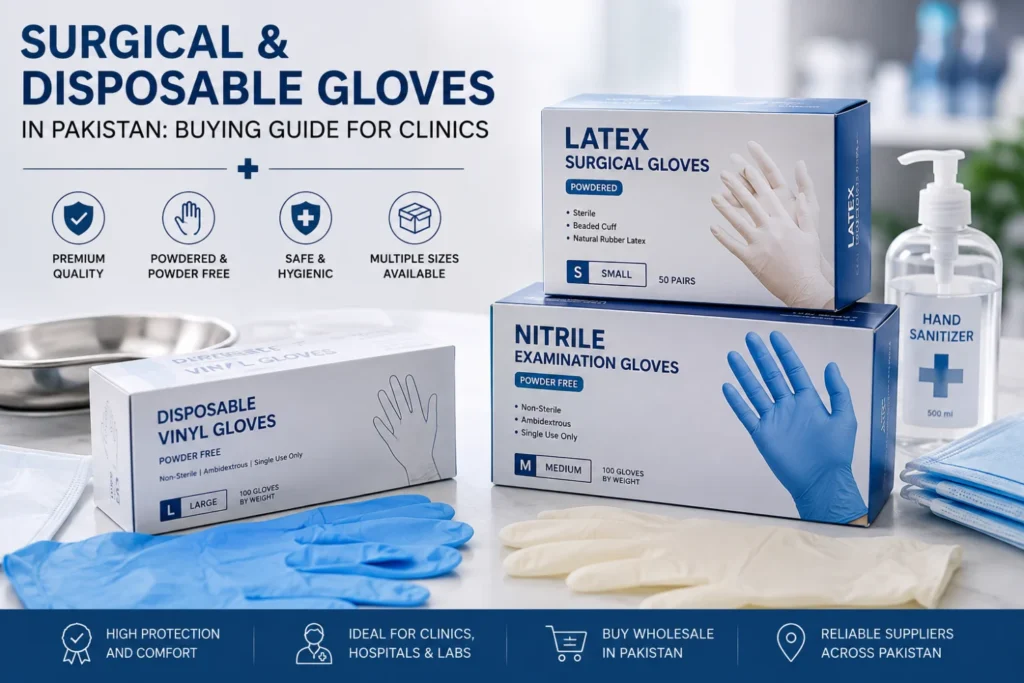
Choosing the right gloves for a clinic in Pakistan comes down to matching the glove to the task: sterile surgical gloves for procedures requiring precision and infection control, non-sterile examination or general-purpose disposable gloves for routine patient contact and administrative tasks, and the right material — latex, nitrile, or vinyl — based on barrier needs, staff allergies, and budget. Getting this match right protects both patients and staff, while getting it wrong either overspends on sterile-grade gloves for tasks that don’t need them or under-protects for procedures that do.
Clinics, hospitals, dental practices, and diagnostic labs all use gloves constantly, but not all gloves serve the same purpose, and treating “gloves” as one interchangeable category leads to either unnecessary cost or inadequate protection for a given task. This guide covers the practical differences a procurement decision actually depends on — material, sterility, sizing, and what to verify before placing a bulk order.
Surgical Gloves vs. Examination/General-Purpose Gloves
- Surgical gloves – Made to a higher manufacturing standard with more precise sizing, better tactile sensitivity, and generally sold sterile. Used for surgical and other procedures where precision and infection control are critical.
- Examination/general-purpose disposable gloves – Used for routine patient examinations, general clinical tasks, and non-procedural contact. Available sterile or non-sterile, with looser sizing tolerances than surgical-grade gloves.
A clinic typically needs both: surgical gloves for procedure rooms and any task requiring precision, and general-purpose disposable gloves for front-desk, cleaning, and lower-risk clinical tasks where surgical-grade sizing and sterility aren’t necessary.
Material Choice: Latex, Nitrile, and Vinyl
- Latex – Offers strong flexibility, comfort, and tactile sensitivity, making it a common choice for procedures requiring fine motor control. The main consideration is latex allergy — both among staff and patients — which is worth screening for before standardizing on latex across a facility.
- Nitrile – A synthetic alternative that avoids latex allergy risk while still offering good durability and puncture resistance, increasingly preferred where allergy exposure is a concern.
- Vinyl – Generally the most economical option, suited to lower-risk, general-purpose tasks rather than procedures requiring high sensitivity or strong barrier protection.
Powdered vs. Powder-Free
Powdered gloves use a cornstarch coating to make them easier to put on, but powder-free gloves are now the more common choice in clinical settings, since starch powder can interfere with wound healing if it contacts tissue during a procedure and has been linked to other complications in sensitive environments. Most clinics today default to powder-free for anything procedure-adjacent, reserving powdered gloves, if used at all, for lower-risk general tasks.
Sterile vs. Non-Sterile
- Sterile gloves – Required for surgical procedures and any task where infection control is critical; typically individually packaged and sealed to maintain sterility until use.
- Non-sterile gloves – Appropriate for routine examinations, general clinical handling, and administrative or cleaning tasks where sterility isn’t clinically required.
Using sterile gloves where non-sterile would suffice adds unnecessary cost at scale; using non-sterile gloves where sterility is required is a genuine clinical risk. Matching this correctly to each task across a facility is one of the more impactful procurement decisions a clinic makes.
Sizing
Glove sizing is typically based on palm circumference, and an improperly sized glove creates real problems: too tight reduces dexterity and increases tear risk during procedures, while too loose reduces tactile precision and can slip during use. Clinics should stock a size range rather than a single default size, since staff hand sizes vary meaningfully across any team.
What to Check Before Bulk Ordering
- Material and allergy considerations – Confirm whether staff have known latex sensitivities before standardizing on one material across a facility.
- Sterile vs. non-sterile stock levels – Match ordering volume to actual usage patterns for each category rather than over-ordering the more expensive sterile stock.
- Consistent sizing availability – Confirm a supplier can reliably stock a full size range, not just the most common size.
- Certification and quality standards – Ask suppliers directly about the manufacturing and quality standards their gloves meet, and request documentation where relevant for your facility’s compliance needs.
- Sample testing before large orders – Test fit, tear resistance, and tactile feel with actual staff before committing to a large bulk order, since specs on paper don’t always reflect real-world performance.
- Storage and shelf life – Gloves have a shelf life, particularly sterile stock; confirm expiry dating and avoid over-ordering beyond realistic usage timelines.
FAQs
What’s the difference between surgical gloves and examination gloves?
Surgical gloves are manufactured to more precise sizing standards with better tactile sensitivity and are generally sold sterile, intended for procedures requiring fine motor control and infection control. Examination gloves are used for routine patient contact and general clinical tasks, with looser sizing tolerances, and are available either sterile or non-sterile depending on the task.
Are powder-free gloves better than powdered gloves for clinical use?
Powder-free gloves are now the more common standard in clinical settings, since powder residue can interfere with wound healing if it contacts tissue during a procedure. Most clinics reserve powdered gloves, if used at all, for lower-risk general tasks rather than anything procedure-adjacent.
Should a clinic use latex or nitrile gloves?
This depends largely on allergy considerations — latex offers strong flexibility and sensitivity but carries a known allergy risk for both staff and patients, while nitrile avoids that risk while still offering good durability. Many clinics now default to nitrile specifically to reduce allergy exposure across a facility.
How do I know what glove size to order for my clinic staff?
Glove sizing is based on palm circumference, and since staff hand sizes vary across any team, it’s best to stock a size range rather than a single default size. An improperly sized glove reduces either dexterity or tactile precision, both of which matter in a clinical setting.
Is it cheaper to buy surgical and disposable gloves in bulk?
Yes, buying gloves in bulk from a wholesale supplier is generally more cost-effective per unit than smaller retail-style orders, particularly for clinics and facilities with steady daily usage across both sterile and general-purpose categories.
Related Posts:

Custom Ramadan Gift Boxes in Pakistan: A Buying Guide
October 5, 2026
No Comments
A Ramadan gift box is only as good as the box itself. The contents matter,

Coffee Shop Packaging in Pakistan: Cups, Lids, Holders & Coffee Pouches
October 4, 2026
No Comments
A coffee shop needs two very different kinds of packaging. One for drinks served to

Kraft & Paper Packaging in Pakistan: Complete Guide for Businesses
October 3, 2026
No Comments
Kraft and paper packaging covers more ground than most businesses realize. Boxes. Bags. Trays. Wraps.
FEEL FREE CONTACT US
info@packaigngmaster.pk
923153127889
Packaging Master, serving Pakistan since 2020, specializes in premium disposable packaging boxes, food packaging, e-commerce cartons, kraft items, and fully customized solutions. Trusted by restaurants, SMEs, retail stores, and online sellers, we deliver durable, eco-friendly packaging with fast nationwide delivery and competitive pricing—making us a leading choice for reliable, high-quality packaging in Pakistan.
Company
Products
Contact Detail
- Rafi Group Landmark Plaza LG 60,61 Jail Road, Lahore
- Phone: +923153127889
- Email: info@packagingmaster.pk
© 2026 Packaging Master. All Rights Reserved.