For orders up to 3k, a 50% advance payment is required for order confirmation.

For orders up to 3k, a 50% advance payment is required for order confirmation.
Within Lahore PKR 250–600 (area-wise) | Out of Lahore PKR 400 (0–3 kg) | Above 3 kg +PKR 130/kg
How to Choose a Packaging Supplier in Pakistan: A Practical Buying Guide for Growing Brands
- Hamza
- No Comments
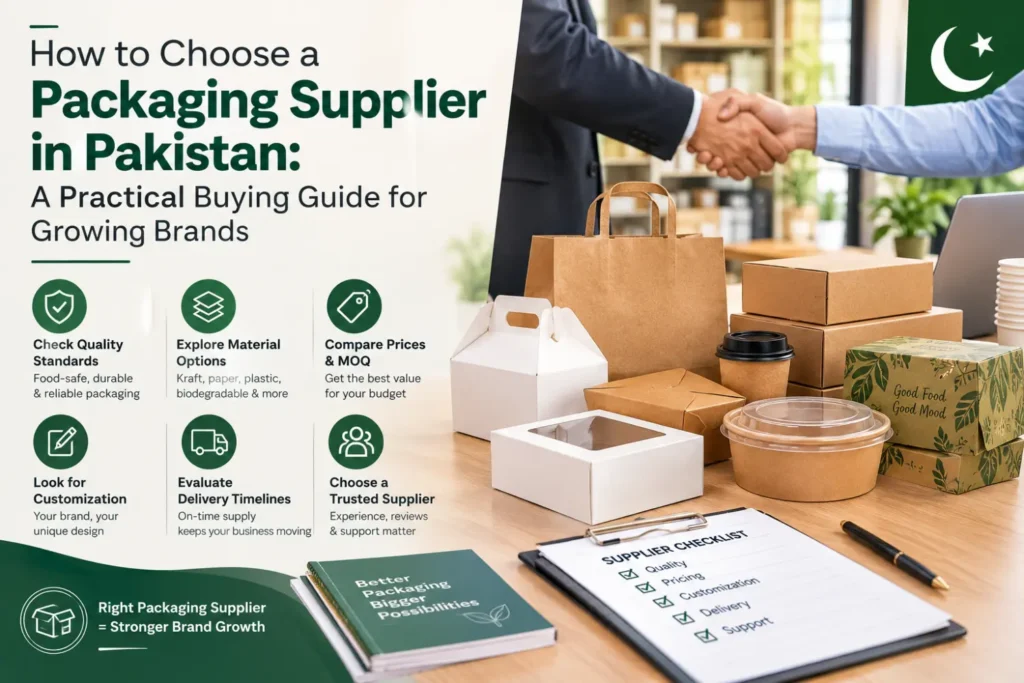
Every damaged shipment, missed deadline, or off-brand box is a small tax on your business — one that compounds every time you reorder. Picking a packaging supplier in Pakistan is really a supply-chain decision disguised as a shopping decision, and it deserves the same scrutiny you’d give a landlord, a bank, or a key hire.
This guide walks through exactly how to vet a packaging vendor: what to check before you pay a rupee, which questions separate a real manufacturer from a reseller, and the warning signs that predict a painful reorder six weeks from now.
Why the Right Packaging Partner Is a Growth Decision, Not Just a Purchasing One
Packaging touches four things that directly move revenue:
- Unboxing experience — for e-commerce and retail brands, the box is the first physical interaction a customer has with you after checkout.
- Product protection — a burger box that leaks or a courier carton that crushes in transit turns into refunds, reviews, and support tickets.
- Unit economics — packaging cost per order affects margin at scale far more than most founders budget for upfront.
- Speed to market — a supplier with unreliable lead times can stall a menu launch, a wedding season order, or an Eid promotion at the worst possible moment.
In other words, the supplier you choose becomes part of your operations, not just your supply list.
9 Factors to Evaluate Before You Choose a Packaging Supplier
1. Material Quality and Food-Grade Compliance
Ask for physical samples, not catalog photos. For food packaging — burger boxes, kraft sandwich boxes, disposable containers, cake boxes — confirm the material is genuinely food-grade and test it under real conditions: grease resistance, seal strength, stacking weight.
2. Certifications and Documentation
A credible food packaging supplier in Pakistan should be able to share material composition details and food-safety compliance without hesitation. If a supplier gets vague the moment you ask for paperwork, treat that as data.
3. Customization and Branding Capability
If you need your logo, brand colors, or a custom die-line, confirm the supplier actually offers custom printing and design support — not just plain stock packaging with a sticker slapped on. Ask how design proofs are handled and how long approval-to-production takes.
4. Minimum Order Quantity (MOQ)
MOQ is where most small and mid-sized businesses get stuck. A supplier that only deals in massive bulk runs isn’t a fit if you’re testing a new SKU or a seasonal item. Look for flexible MOQs that let you scale a design up gradually instead of committing to a warehouse of one box style.
5. True Cost Per Unit
Compare the full landed cost, not the headline price per piece:
- Delivery and courier charges
- Printing/customization add-ons
- Advance payment terms
- Wastage or defect rate on past orders
A supplier that’s 5% more expensive per unit but has near-zero wastage almost always wins on total cost.
6. Delivery Reliability and Lead Times
Ask for average lead times on both stock and custom orders, and ask what happens during peak periods — Eid, wedding season, Ramadan, winter menu launches — when every supplier in the country gets slower at once.
7. Communication and After-Sales Support
How a supplier handles a damaged batch or a reorder tells you more than any sales pitch. Confident, specific answers are a good sign; vague reassurances are not.
8. Sustainability and Eco-Friendly Options
More Pakistani consumers now notice biodegradable and kraft-based packaging over plastic-heavy alternatives. If sustainability matters to your brand positioning, ask what eco-friendly materials the supplier actually stocks — not just what they claim on their homepage.
9. Scalability
Can the supplier support you at 500 units a month and still support you at 50,000? A vendor who can’t grow with you becomes a bottleneck exactly when your business is finally working.
Packaging Supplier vs. Packaging Manufacturer: Know the Difference
| Aspect | Packaging Supplier | Packaging Manufacturer |
| Sourcing | Buys and resells packaging | Produces in-house |
| Customization | Often limited | Typically more flexible |
| Pricing at scale | Includes a middleman margin | More competitive on bulk orders |
| Best for | Small, varied orders | Repeat, brand-specific production |
Many Pakistani businesses end up managing five different vendors — one for boxes, one for pouches, one for printing — simply because their first “supplier” was really just a reseller. A partner that manufactures and stocks a wide product range under one roof removes that friction entirely.
A Step-by-Step Process for Selecting a Packaging Vendor
- Define your specs first — material, size, order volume, and budget, before you contact anyone.
- Shortlist 3–4 vendors based on their actual product catalog and industry focus (food, retail, e-commerce).
- Request real samples and stress-test them — don’t approve based on photos.
- Compare full quotes side by side: unit price, MOQ, lead time, delivery cost, payment terms.
- Check verifiable reviews or client references, not just testimonials on the vendor’s own site.
- Run a small trial order before signing on for a long-term or bulk arrangement.
- Evaluate the reorder experience — this is the relationship you’ll actually live with.
Questions Worth Asking Before You Commit
- What’s your MOQ, and is there flexibility for a first-time or trial order?
- Can you send physical samples before I place a bulk order?
- What’s your average turnaround for custom-printed vs. stock packaging?
- Do you offer food-grade, biodegradable, or kraft alternatives?
- What’s your process if a batch arrives damaged or off-spec?
- Can you scale with me if my order volume triples next quarter?
- Do you offer free or paid graphic design support for custom branding?
A supplier with nothing to hide answers all of these directly, usually within one conversation.
Red Flags That Should Make You Pause
- Pricing far below the market average with no clear explanation
- No samples available before payment
- Demands for full payment upfront with zero milestone structure
- Slow, inconsistent, or evasive communication
- No verifiable business address, reviews, or track record
- Reluctance to discuss material sourcing or specifications
Two or more of these together is usually enough reason to widen your search rather than rush the order.
Signs You’re Dealing With a Trustworthy Packaging Company
- A real, verifiable business address — not just a phone number and a WhatsApp chat
- Detailed product specifications, not just stock photography
- Willingness to send samples before you commit to volume
- Transparent, itemized pricing with no surprise charges later
- Realistic delivery timelines, stated upfront
- A visible track record with recognizable clients or repeat business
Why a Local, Lahore-Based Supplier Often Wins for Pakistani Businesses
For most small and mid-sized brands, sourcing locally beats importing or working with a distant vendor:
- Faster turnaround — no international shipping delays eating into your launch timeline
- Lower MOQs, which matter enormously when you’re still testing a product line
- Direct communication in the same language, time zone, and business culture
- Faster problem resolution on reorders, adjustments, or urgent top-ups
- Shorter, more resilient supply chains, especially valuable during peak seasons like Eid and wedding season
For restaurants, cafés, and food brands specifically, working with a locally based wholesale packaging supplier also means faster access to essentials — think burger boxes, kraft sandwich boxes, and shawarma boxes — right when demand spikes.
Matching the Supplier to Your Business Type
| Business Type | What to Prioritize |
| Restaurants & Cafés | Fast delivery, food-grade material, competitive bulk pricing |
| Bakeries & Home Bakers | Custom printing, presentation-first packaging, low MOQs |
| E-commerce Sellers | Durable, protective cartons and mailers |
| Retail & Fashion Brands | Branded paper bags, premium finishes, consistent print quality |
| Umrah/Zam Zam & Gifting Businesses | Premium presentation boxes, seasonal turnaround speed |
Sourcing all of these categories from one packaging partner — rather than juggling separate vendors per product type — is usually the difference between a smooth reorder process and a logistics headache every month.
Where Packaging Master Fits Into This Checklist
Packaging Master has operated out of Lahore since 2020, supplying disposable, custom, and eco-friendly packaging to restaurants, retail brands, and e-commerce sellers across Pakistan — with client work for names like Shan Foods, Bisconni, Burger Lab, Khaadi, and Beechtree. That runs alongside the same fundamentals covered above: competitive per-unit pricing, free graphic design support on custom orders, quick turnaround, and nationwide delivery from a verifiable Lahore address rather than a WhatsApp number alone.
If you’re actively comparing suppliers, it’s worth browsing the full product catalog — from kraft boxes and cake boxes to SOS paper bags and disposable food containers — and requesting a sample before your next bulk order.
Ready to compare pricing or request a sample? Get a quick quote on WhatsApp or reach the team directly at info@packagingmaster.pk.
Frequently Asked Questions
How do I choose the right packaging supplier in Pakistan? Start by defining your material, volume, and budget requirements, then shortlist suppliers based on sample quality, MOQ flexibility, pricing transparency, and delivery reliability — and always place a small trial order before committing long-term.
What’s the difference between a packaging supplier and a packaging manufacturer? A supplier typically sources and resells packaging, while a manufacturer produces it in-house — usually meaning better pricing and more customization once you order at scale.
What is a reasonable MOQ for a small business in Pakistan? It depends on the product, but suppliers offering low or flexible MOQs are generally a better fit for businesses testing new packaging designs rather than committing to a full production run upfront.
Why choose a local supplier over importing packaging? Local suppliers offer faster delivery, lower MOQs, easier communication, and quicker after-sales support — all of which matter more for small and growing businesses than a marginally lower unit price from overseas.
What are the biggest red flags when picking a packaging vendor? Unusually low pricing with no explanation, no samples before payment, demands for full advance payment, poor communication, and no verifiable business history or reviews.
Does Packaging Master offer custom branded packaging? Yes — custom printing, sizing, and free graphic design support are available across most product categories, from food packaging to retail and gifting boxes. Contact the team to discuss your specs.
Related Posts:
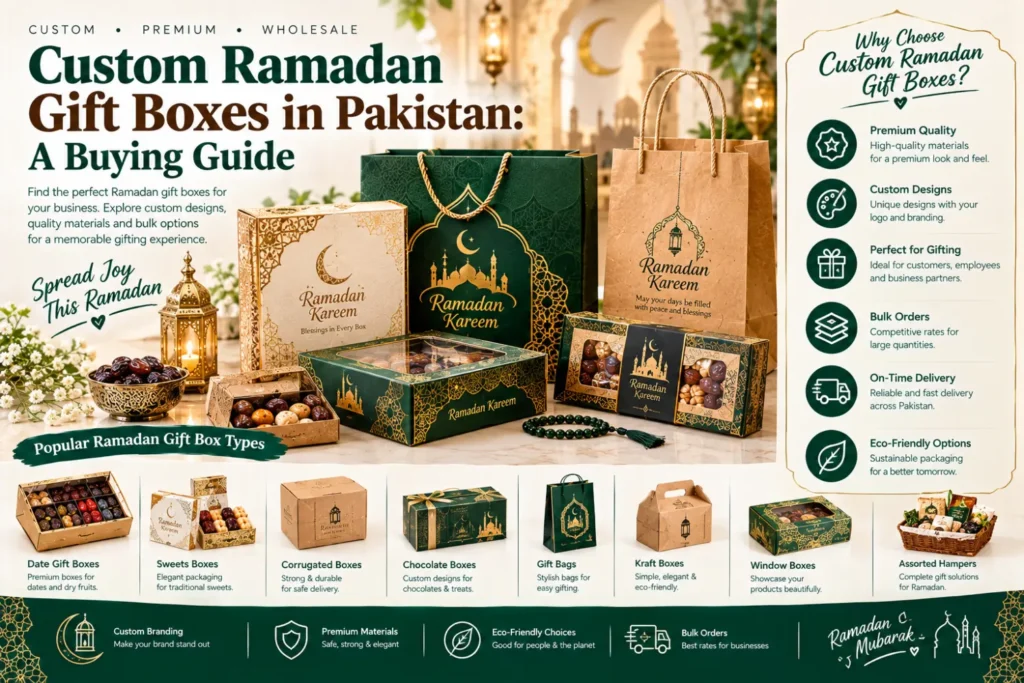
Custom Ramadan Gift Boxes in Pakistan: A Buying Guide
October 5, 2026
No Comments
A Ramadan gift box is only as good as the box itself. The contents matter,
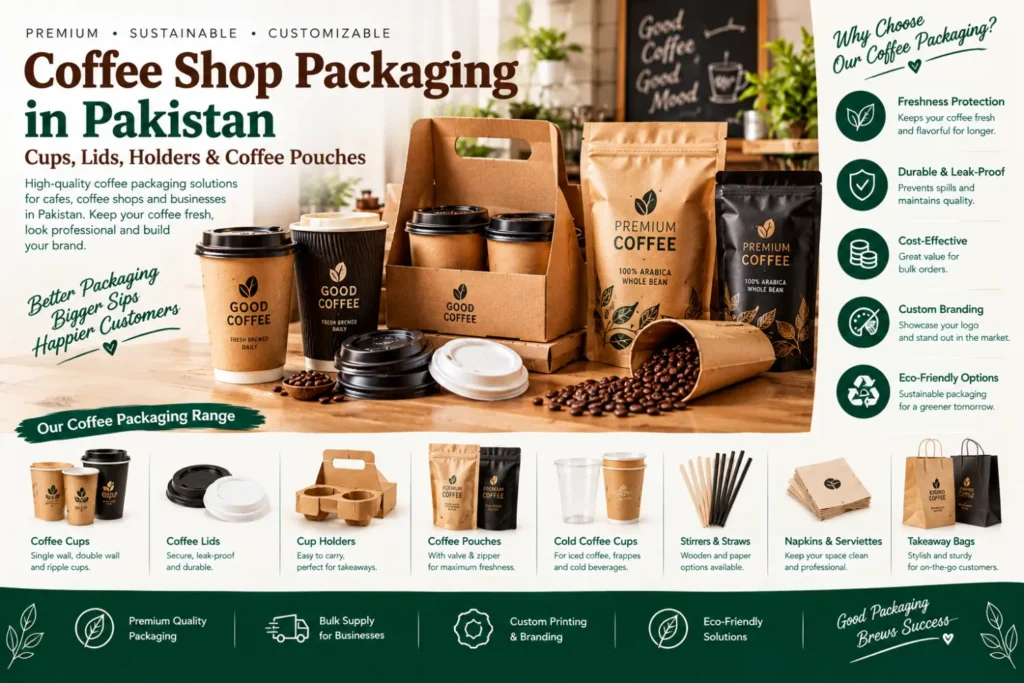
Coffee Shop Packaging in Pakistan: Cups, Lids, Holders & Coffee Pouches
October 4, 2026
No Comments
A coffee shop needs two very different kinds of packaging. One for drinks served to
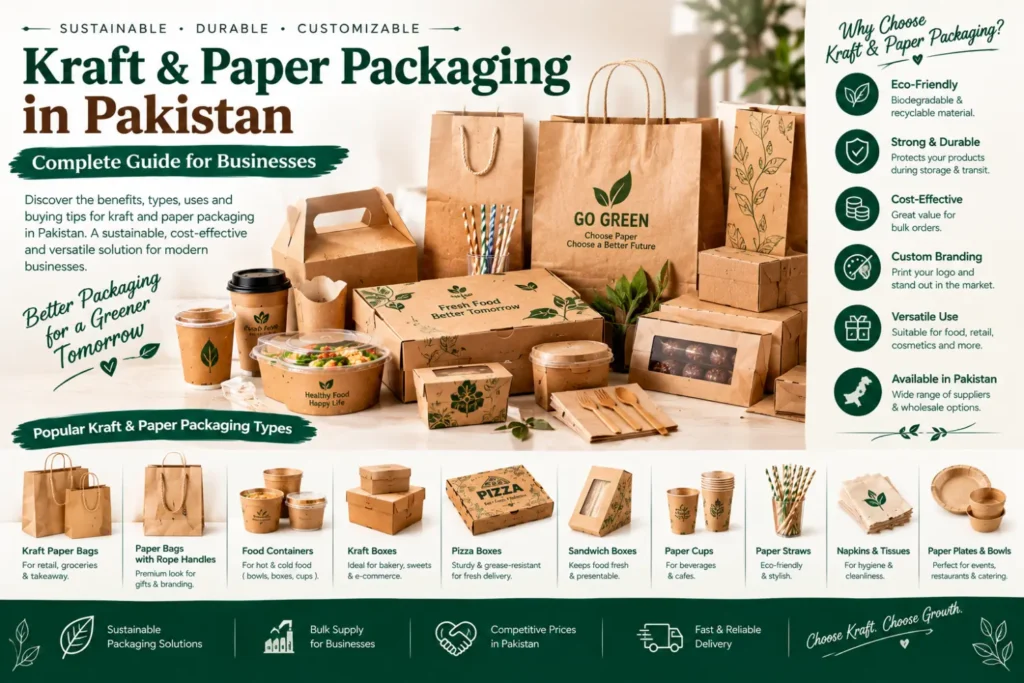
Kraft & Paper Packaging in Pakistan: Complete Guide for Businesses
October 3, 2026
No Comments
Kraft and paper packaging covers more ground than most businesses realize. Boxes. Bags. Trays. Wraps.
FEEL FREE CONTACT US
info@packaigngmaster.pk
923153127889
Packaging Master, serving Pakistan since 2020, specializes in premium disposable packaging boxes, food packaging, e-commerce cartons, kraft items, and fully customized solutions. Trusted by restaurants, SMEs, retail stores, and online sellers, we deliver durable, eco-friendly packaging with fast nationwide delivery and competitive pricing—making us a leading choice for reliable, high-quality packaging in Pakistan.
Company
Products
Contact Detail
- Rafi Group Landmark Plaza LG 60,61 Jail Road, Lahore
- Phone: +923153127889
- Email: info@packagingmaster.pk
© 2026 Packaging Master. All Rights Reserved.